
Website Design
We design websites that are pleasant to look at, straightforward to use, quick to load, findable in search, and built to turn a visitor into an enquiry. Those are not competing goals — but they do have to be designed together, from the start, by people who understand all of them.
Discovery — who buys from you, what they need to know, what stops them, and a genuine look at three competitors · A structure and content plan agreed before any visual work begins · Wireframes, so decisions about what matters most on a page are made before anyone is distracted by how nice it looks · Two or three visual concepts for a key page, then the chosen direction developed across the rest
On this page
- What actually decides whether a website design works?
- What kinds of website do we design?
- Why is search visibility decided during design rather than afterwards?
- How fast should your website be, and what makes it slow?
- Does site speed actually affect rankings, or just conversions?
- Whose websites have we designed?
- What should you ask before someone designs your website?
- What drives the cost of a website in the West Midlands?
- What is included in every project, and what is not?
- Do you work with businesses outside the West Midlands?
What actually decides whether a website design works?
Not whether it is modern, clean or professional. What decides it is a set of quieter questions. Does a visitor understand what you do within five seconds of landing? Is the one thing you want them to do obvious on every screen? Does the page answer the objection they arrived with? Can they find your phone number on a mobile without pinching? Does the form ask for the least it can get away with?
Get those right with a plain design and you will out-perform a beautiful site that got them wrong. Get them right and make it beautiful, and you have something worth the money. Most businesses commissioning a website describe what they want in visual terms, which is understandable and is not the thing that decides whether it works.
Three things we see constantly on sites we are asked to replace. A homepage that describes the company rather than the customer's problem — “we are a leading provider of innovative solutions” tells a visitor nothing they can act on. A contact form asking for eleven fields, when every field costs you enquiries and most businesses need three and a message box. And no answer to the question the buyer actually arrived with, which is nearly always some version of what it costs, how long it takes, and whether you have done this before. Those three are also the first things we look at in structured conversion work on a site that already has traffic.
The point
A homepage that describes the company rather than the customer's problem — “we are a leading provider of innovative solutions” tells a visitor nothing they can act on.
What kinds of website do we design?
Six disciplines: business and brochure sites, e-commerce, booking and portal interfaces, design systems, UX research and wireframing, and accessibility. They overlap on most projects. The first is the core case; the rest are what a project turns into once the requirement is properly understood.
- Business and brochure websites. Clear positioning, service pages with enough substance to rank and to convince, proof, and an obvious path to getting in touch.
- E-commerce. Product and category design, filtering that works on a phone, and a checkout that does not lose people at the last step — designed alongside the store build itself rather than handed over to it.
- Booking, portal and application interfaces. Where the website is not a brochure but something people log into and use. Different discipline, different rules, and usually a job for an application build rather than a website project.
- Design systems. Colour, type, spacing, components and patterns, documented so that the site still looks coherent after two years of additions by different people. Worth it for anyone who will keep adding pages — which is everyone.
- UX research and wireframing. Before anything visual: what the pages are, what goes on them, in what order, and why. This is where the thinking happens, and skipping it is why redesigns so often fail to change anything.
- Accessibility. Contrast, keyboard navigation, semantic structure, alternative text, sensible focus states. Better for every user, better for search engines, and a legal consideration for many organisations. Designed in from the start — retrofitting accessibility is expensive and never quite works.
Why is search visibility decided during design rather than afterwards?
Because the decisions that determine what can rank are all design decisions. The page structure determines what can rank at all. The heading hierarchy determines what a search engine understands. Image handling and layout decisions determine load speed and Core Web Vitals. And the rendering approach — whether content exists in the page source or is drawn by JavaScript after load — determines whether a search engine or an AI crawler can read the site at all.
A large proportion of the sites we are asked to fix were designed beautifully by people who had no involvement in whether anyone would ever find them. That last point is not theoretical either. We have seen sites where every page served identical markup to a crawler, with no title, no heading and almost no text, because everything was rendered client-side. It is a common failure in modern builds and it is invisible unless somebody looks. We check it as standard, because we have fixed it — including on our own website, which is the kind of thing a crawl, render and indexation audit exists to catch.
So the SEO specialist is involved in the design, not handed the finished thing afterwards. That is why the pages are structured the way they are before anyone chooses a colour, and why a new site starts from a position where search work has something to build on.
How fast should your website be, and what makes it slow?
Google treats a largest element painted within 2.5 seconds, interactions answered within about 200 milliseconds and almost no layout movement as good. On a design-led site the things that break those numbers are visual decisions: hero imagery, sliders, webfonts and blocks that reserve no space before they load. How the pages are turned into a working build decides the rest.
| Metric | What it measures | What usually breaks it |
|---|---|---|
| Largest Contentful Paint (LCP) | How long until the biggest thing on the screen — usually the hero image or the headline — has actually been painted. Good is 2.5 seconds or less. | An uncompressed hero photograph exported straight from a camera, a full-width slider that loads every slide up front, and background images set in CSS so the browser finds them late. |
| Interaction to Next Paint (INP) | How quickly the page visibly responds when someone taps a menu, opens an accordion or picks a filter. Good is around 200 milliseconds. | Heavy animation libraries, a mega-menu rebuilt in JavaScript, and third-party tags — chat widgets, heatmaps, consent banners — competing for the same main thread. |
| Cumulative Layout Shift (CLS) | How much the page moves under the reader's thumb after it first appears. Good is 0.1 or less. | Images and embeds with no width and height reserved, webfonts that load late and reflow every heading, and ads or cookie bars injected above content already on screen. |
| Time to First Byte (TTFB) | How long the server takes to start answering at all, before the design gets a chance to do anything. | A cheap shared host, an uncached content management system rebuilding every page on request, and redirect chains left over from the last redesign. |
Does site speed actually affect rankings, or just conversions?
Both, but not equally. Speed is a tie-breaker in search rather than a primary ranking factor: a fast page will not outrank a genuinely more relevant slow one, but between two comparable pages it can decide which comes first. The stronger commercial argument is almost always the conversion one.
People leave slow pages, and they leave before they have read anything you wrote. We are not going to attach a percentage to that, because the honest answer is that it depends on the site, the device and how patient the visitor was feeling. What we will say is that on a design project the fix is usually cheap and structural: compress the hero image properly, drop the slider nobody interacts with, give every image and embed its dimensions, and load the webfont so text stays readable while it arrives.
Where speed is genuinely a ranking problem, it is normally a symptom of something else — a rendering approach a crawler cannot follow, a redirect chain, a server that is slow to answer. That is the technical side of search rather than a design job. Where it is a conversion problem, the way to find out is to measure it against the enquiry rate, which is what testing changes on a page that already has traffic is for.
Whose websites have we designed?
We have designed and built websites for Delta Hospital & Research Center, Aama Jewellers, Himalayan Clean Energy, RM Agrotech, Fit and Fine and Company Services Nepal, across healthcare, retail and jewellery, renewable energy, agriculture and professional services — and delivered search work for AOne Biz.
We will be straight with you: that record is international rather than UK-based. We are a UK business building a UK portfolio, and we are not going to dress up sector labels as local case studies. What we will do is show you the live sites, walk you through the decisions behind them, and introduce you to the people who built them. The delivered projects are there to look at.
The point
We will be straight with you: that record is international rather than UK-based.
What should you ask before someone designs your website?
Ask the nine questions below, and listen for a specific answer rather than a reassuring one. A good answer names a person, a stage or a file format. A vague answer — “we will sort that out later” — is where the arguments and the extra invoices come from.
- Who writes the copy? A good answer says who, at which stage, and what happens if the words are late, because on most projects it is the content and not the design that holds everything up. If the answer is you, ask for a brief per page. What a website actually costs in the UK moves on this more than on almost anything else.
- Who supplies the photography? A good answer is one of three: you do, to this specification; we will arrange a photographer, priced separately; or stock, and here is who pays for the licence. Anything vaguer means stock images chosen in a hurry the week before launch.
- How many rounds of revisions are included? A good answer is a number, with what counts as a round and what happens after them. Unlimited revisions usually means either a padded price or an argument later.
- What happens to this content on a phone? A good answer describes what gets reordered, collapsed or dropped, page by page. The weak answer is “it is responsive”, which only tells you the layout will not break — not that it will still make sense at the width most of your visitors actually use.
- Who owns the design files at the end, and in what format? A good answer names the tool and confirms the files transfer to you. If the design lives only in an account the agency controls, your next designer starts from a screenshot.
- Is this a template, a theme with our logo in it, or designed for us? All three are legitimate purchases. Only one of them is what most people think they are paying for, so ask which you are buying and have it stated in writing.
- How will it be built, and what is it built on? A good answer names the platform and explains why that one rather than the alternatives. Whether WordPress or a custom build fits is a decision you want made in front of you, not announced afterwards.
- What happens to our existing URLs? A good answer mentions mapping every one of them and putting 301 redirects in place before launch. No answer at all is the single most expensive mistake in a redesign.
- What is not included? A good answer is a list — hosting, maintenance, paid stock or fonts, content beyond an agreed allocation. Ask it of a freelancer, an agency and an in-house hire alike, because the three routes carry different hidden costs.
What drives the cost of a website in the West Midlands?
The type of site decides the cost, and “a website” covers things ten times apart. The bands below are how to place yourself; what moves you within one is page count, whether copy and photography are included, how many systems it connects to, and how bespoke the design is. They are the same bands used for the build stage, because for most projects design and build are one piece of work.
| Type | What it is |
|---|---|
| Starter | Up to about 8 pages. Custom design, mobile-first, contact forms, basic SEO setup, content management so you can edit it. Suits a local business or a new venture. |
| Business | 10–25 pages, full content management, service and location page architecture, blog, structured data, conversion-focused layouts, analytics and tracking. The most common project. |
| E-commerce | Product catalogue, payments, shipping and VAT, stock and accounting integration, optimised checkout. |
| Custom build | Portals, applications, complex integrations, multi-language or multi-site. Scoped individually. |
What is included in every project, and what is not?
Responsive design, accessibility fundamentals, server-rendered pages, speed optimisation, analytics, redirect mapping and training are in every project. Hosting, maintenance, paid stock and fonts, and content beyond an agreed allocation are not. What moves the number is page count, who writes the copy, photography, integrations, and how bespoke the design is.
- Included in every project: responsive design, accessibility fundamentals, server-rendered pages, page speed optimisation, analytics setup, redirect mapping from your old site, and training.
- Not included: ongoing hosting and maintenance, which is sold as monthly website care plans instead.
- Not included: paid stock photography or fonts.
- Not included: content writing beyond an agreed allocation.
- We will tell you which of these apply before you sign, not afterwards.
Do you work with businesses outside the West Midlands?
Yes, and most of the work runs the same way wherever you are. Discovery happens on a call, the structure and the wireframes arrive as documents you can comment on, the build sits on a staging site you can open at any time, and decisions get written down rather than remembered.
What proximity changes is how easy it is to meet. We are registered in Oldbury, so if you are in Birmingham or the wider West Midlands, sitting in a room together once at the start is straightforward and often worth doing. Further afield, that conversation happens on a call and very little is lost. We have no other offices and will not pretend to local knowledge of a town we have never worked in — if that matters to your project, say so early. The sites we have already delivered are a better guide than a postcode, and the quickest way to find out whether we are a fit is to tell us what you are trying to build.
The point
We are registered in Oldbury, so if you are in Birmingham or the wider West Midlands, sitting in a room together once at the start is straightforward and often worth doing.
How We Work
Discovery
Who buys from you, what they need to know, what stops them, what you need the site to achieve, and what is wrong with the current one. Plus a genuine look at three competitors.
Structure and content plan
What pages exist, what goes on each, how they link, and what needs writing. Agreed before any visual work — this is the stage clients are most tempted to rush and most regret rushing.
Wireframes
Layout and hierarchy in grey boxes, so decisions about what matters most on a page are made without being distracted by how nice it looks.
Visual design
Two or three concepts for a key page, then development of the chosen direction across the rest. You see real designs, not a mood board.
Explore Related Services
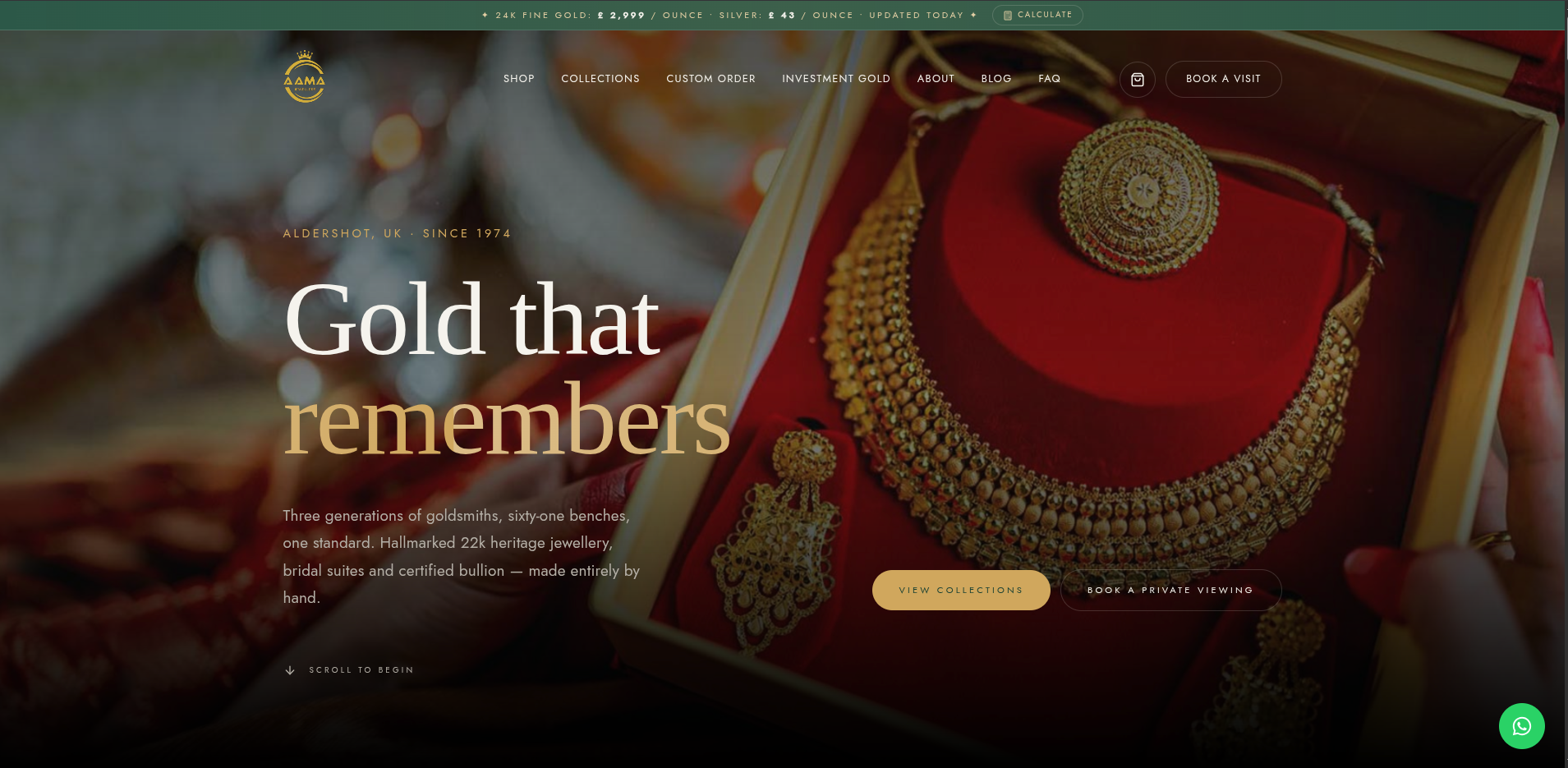
Aama Jewellers
A modern storefront replacing an outdated site, with a shorter checkout and social campaigns feeding it — built and handed over as one piece of work rather than two suppliers pointing at each other.
View Case StudyFrequently Asked Questions
How much does a website cost in Birmingham?
“A website” describes things ten times apart in cost, so a single number would tell you nothing useful. What separates them is page count, whether copy and photography are included, how many other systems the site connects to, and how bespoke the design is. We scope it on a call before quoting.
How long does a website take to design and build?
It depends on three things, and only one of them is us. The size of the site, how many systems it has to connect to, and — the usual cause of delay on nearly every project — how quickly the content arrives. If speed matters, have the words and images ready, or ask us to write them.
Will I be able to edit the site myself?
Yes. Every site is built on a content management system so you can change text, swap images, add pages and publish posts without needing us. We train you at handover and leave you written documentation. You should never have to pay a developer to correct a typo.
Do you design on a template or from scratch?
From scratch, to your brand. We use proven layout patterns for things like navigation and checkout, because reinventing conventions users already understand makes a site harder to use, not more original. But the design is yours and is not a theme with your logo dropped into it.
Is the site built to be found on Google?
Yes, and the structure is planned for it before the design begins: server-rendered pages so crawlers can read the content, proper heading hierarchy, unique titles and descriptions, structured data and a sensible URL structure. That gives you a site capable of ranking. Actually ranking for competitive terms is ongoing search work.
Who owns the design and the code when it is finished?
You do, on final payment — the design files, the code and the content. You can take the site to another developer whenever you like, and we will answer their questions during the handover. We do not hold your site, your domain or your hosting as leverage.
Do you handle hosting and ongoing support?
Yes, on monthly care plans covering updates, security, backups, monitoring and included time for content changes. It is optional — if you have arrangements you are happy with, we will work with them. The tiers are set out on the website care plans page.
Can you redesign our existing site without losing our rankings?
Yes, and this is where redesigns most commonly go wrong. Before launch we map every existing URL, check which pages earn traffic and links, and put 301 redirects in place so that value transfers rather than evaporating. Expect a short dip while the new site is re-crawled, and expect it to recover.
Do you write the content?
We can, and it is usually worth it. Copywriting is priced separately so you can choose. If you write it yourself we will give you a brief per page covering what to cover, roughly how long, and the search terms it should serve.
Let's Build Something That Matters.
Tell us what you're trying to achieve and we'll help you find the right solution.