
Bespoke Software Development
It started as a way of tracking something. Then it acquired formulas, then tabs, then a second version for the branch office, then colour coding that only one person fully understands. It now runs a meaningful part of the operation, it exists in six slightly different copies, and if the person who built it left tomorrow you would have a genuine problem.
What is included
- Discovery on site where possible, watching the work happen rather than reading the process document
- Process mapping written down and shown back to you before anything is priced
- A written scope with a fixed price for phase one, a timeline, and an explicit list of exclusions
- Interface designs and a clickable prototype of the main screens before development starts
- Two-week sprints, each ending in a working version you can log into
On this page
- What is bespoke software, and what does it look like in practice?
- When does a spreadsheet become a business risk?
- What if only one of those is true?
- What kinds of software do we build?
- Should you build bespoke software or buy off the shelf?
- When does bespoke software beat off-the-shelf, and when does it lose?
- Should you outsource software development or build it in-house?
- How do you choose a software development company?
- What should you ask any software company before you sign?
- What does software discovery actually produce?
- What does a software development consultant do, and is discovery the same thing?
- What scale of software build are you looking at?
- What actually moves the price of a software project?
- How do you judge the assumptions in a software quote?
- What would we tell you not to build?
- What does it take to make two systems talk to each other?
- What are the integration risks in a software project?
- Does the programming language matter for bespoke software?
- What do reporting and dashboards actually give you?
- What happens to the data in the old system?
- Who owns the software, and how is it secured and supported?
- Will it still work when the business is twice the size?
- What happens if you want to move to another developer?
- What have we built, and where?
- Do you work with businesses outside the West Midlands?
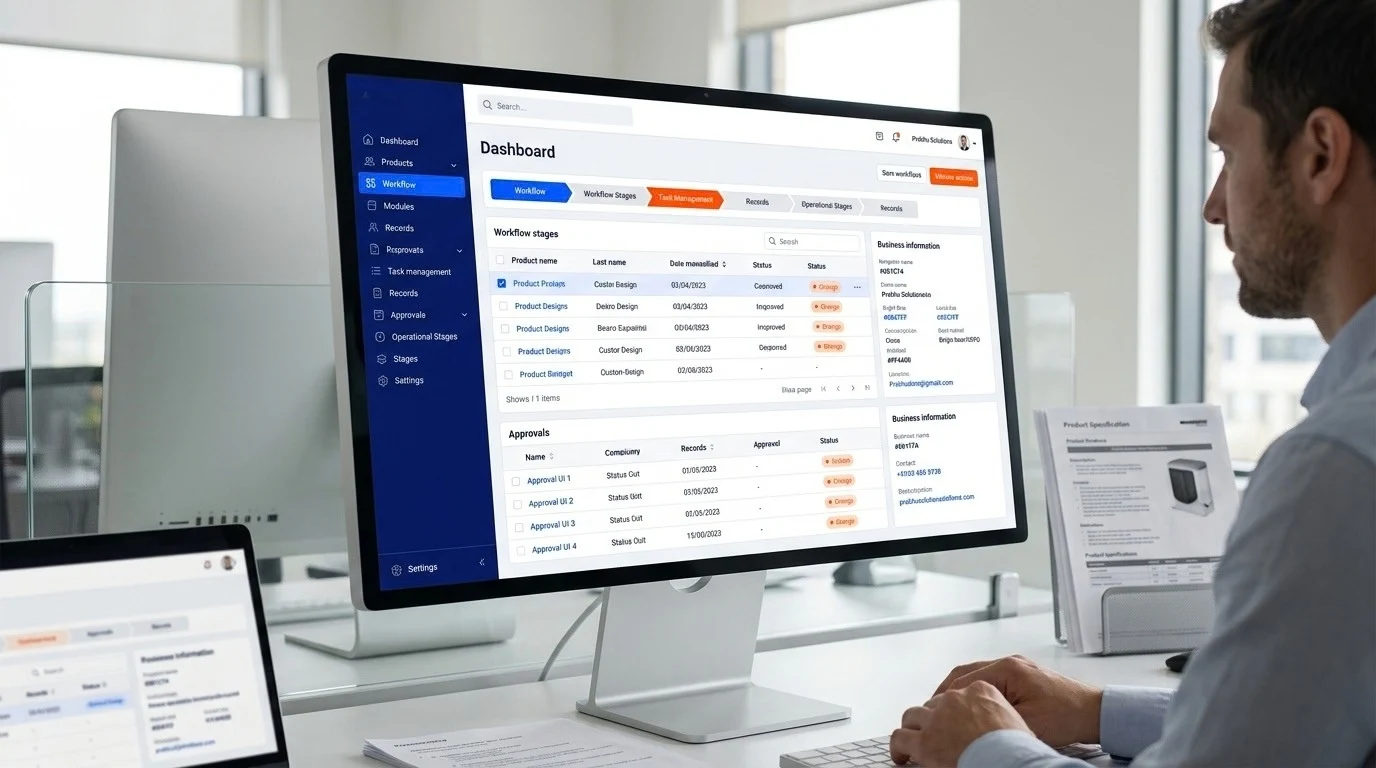
What is bespoke software, and what does it look like in practice?
Bespoke software is software written for one organisation's way of working, rather than sold as a product to many. It is also called custom or tailor-made software. You own the code on final payment, and the system does what your process needs and nothing else. Job-management systems, customer portals and quoting tools are typical examples.
A typical case is a job-management system for a trades business: the enquiry, quote, schedule, job sheet and invoice held in one place instead of four spreadsheets, and connected to the accounts package. Another is a portal where a supplier uploads documents and checks order status without emailing anyone. Neither would be sold as a product, because the process is specific to the firm. What bespoke software is, with more examples, is set out in its own guide.
Bespoke, custom and tailor-made mean the same thing in practice, and bespoke software development in the UK describes the same service as custom software development. Bespoke does not mean built from nothing: sensible builds use proven frameworks and libraries, and what is written for you is the part that is specific to your process. A company whose product is the software is a different case, and startups and scale-ups have their own sector page.
When does a spreadsheet become a business risk?
When losing one person, or one file, would stop part of the operation. The tipping point is rarely dramatic — it usually looks like one of the six patterns below. If two or three of them are true of your business, there is probably a case for bespoke software.
- The same information gets typed in three times. Once into the quote, once into the job sheet, once into the accounts. Every re-entry is a chance to get it wrong, and somebody spends hours a week doing it.
- Nobody can answer a simple question quickly. How many jobs are open. What the margin was on that contract. Which customers have not ordered since spring. The data exists, spread across systems that do not talk, and answering takes someone half a day with an export.
- The process lives in one person's head. They know which spreadsheet is current and which supplier needs the special treatment. Holidays are stressful. Their resignation would be a crisis.
- Off-the-shelf nearly works. Each product does 70% of what you need and forces an awkward workaround for the rest. You are considering changing how you work to suit the software, which is the wrong way round.
- You are paying per seat for capability you do not use. Licences across a growing team, year after year, for a fraction of the features. This is also the most common reason businesses ask us about a CRM built around their own pipeline.
- Growth has hit a ceiling made of admin. Taking on 30% more work would mean taking on another administrator, and the maths has stopped working.
What if only one of those is true?
Then there may not be a case, and we will tell you. A system nobody needed is a bad advertisement sitting in someone's office for years, which is a worse outcome for us than a project we did not win.
What kinds of software do we build?
Eight categories, all of them shaped around an existing operation rather than sold as a product. Most projects combine two or three of them — a business system with a customer portal attached, or a reporting layer over an integration.
- Internal business systems. Job and order management, scheduling, resource planning, stock, service records, compliance and document management. The systems that run the operation rather than the ones that market it.
- Customer and supplier portals. Somewhere your customers can check an order, download a document, submit a request or approve a quote without emailing someone. Usually pays for itself in reduced inbound admin faster than anything else on this list, and it is the most common starting point for a browser-based application people log into.
- Workflow and approval systems. Multi-step processes with rules, permissions, sign-offs and an audit trail. Anything currently held together by an email chain and a shared folder.
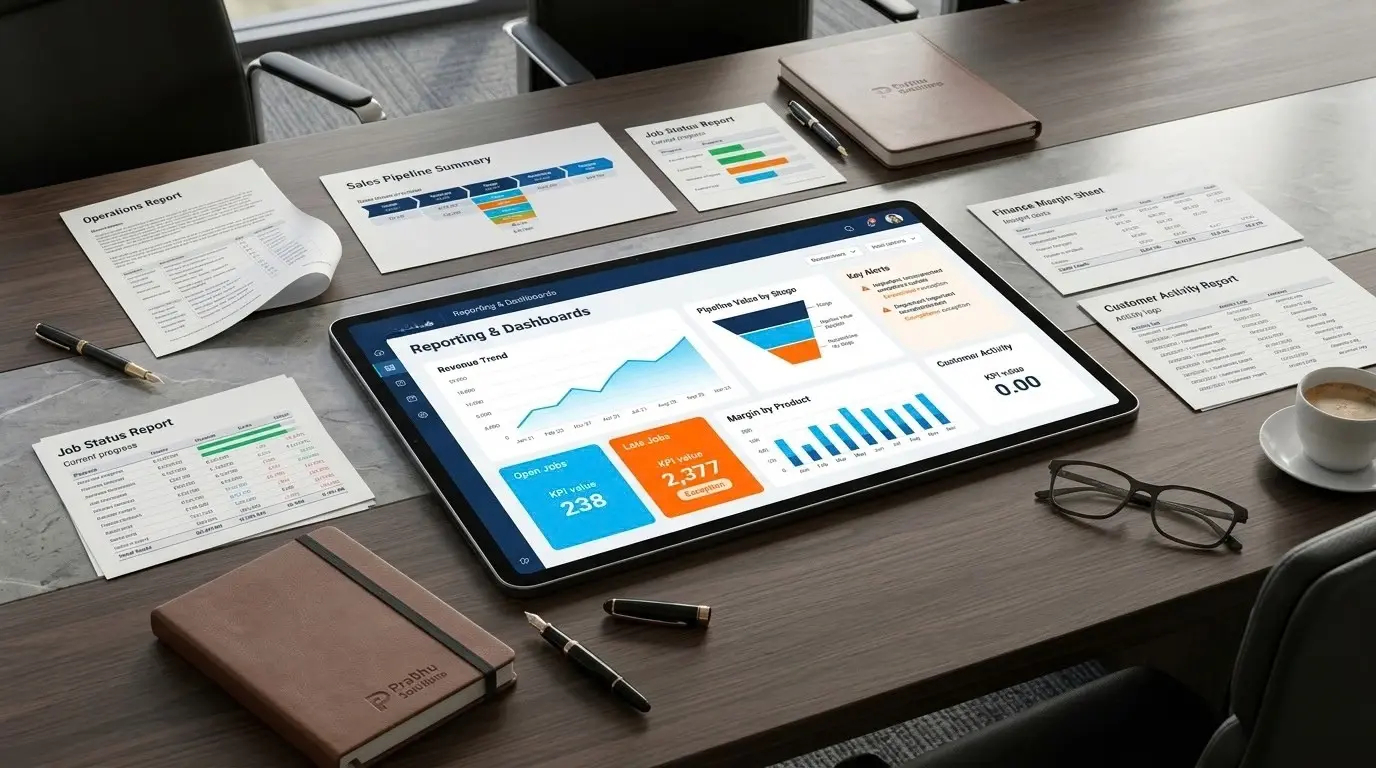
- Reporting and dashboards. Live figures pulled from the systems that hold them, presented as the questions your managers actually ask, refreshed automatically instead of assembled by hand each month.
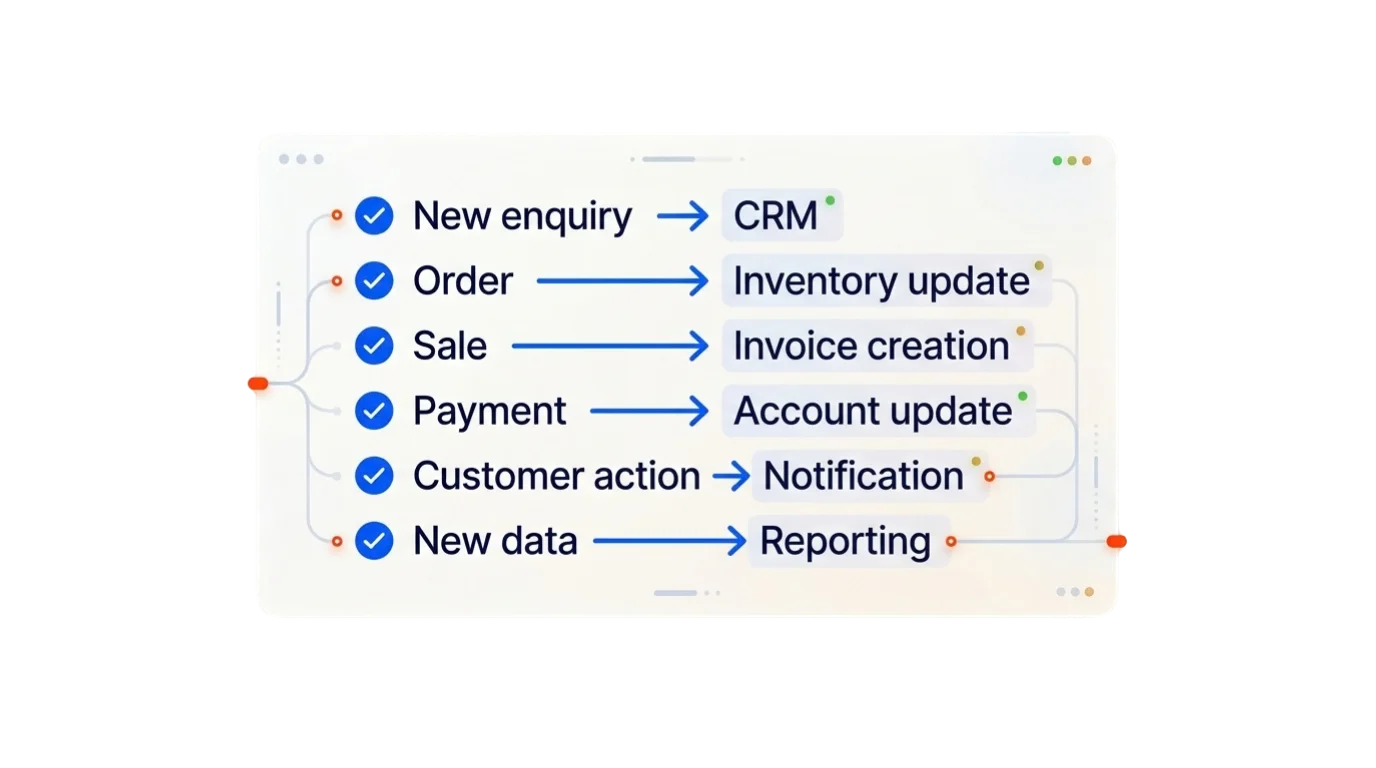
- Integration between systems you already run. Making your website talk to your accounts package, your production system talk to your stock, your CRM talk to your telephony. Often the fastest way to remove real cost without replacing anything.
- API development. Building an API so your systems, your partners or your customers can connect to your data securely. Also consuming other people's APIs when the documentation is poor or absent, which is more common than vendors admit.
- Legacy replacement. The Access database from 2009. The bespoke system whose developer disappeared. The VB application nobody dares update. Replacing these carefully, in phases, without stopping the business.
- Data migration. Getting years of accumulated information out of the old system and into the new one, cleaned, de-duplicated and reconciled so you can verify it before go-live.
Should you build bespoke software or buy off the shelf?
Buy off the shelf when your process is broadly standard, you need it working in weeks, or the scope is too small for bespoke to earn its keep. Build bespoke when you have already tried products and are working around all of them. We build bespoke software, so treat our view with appropriate scepticism — and then read the row where we argue against ourselves.
| Route | When it is the right call |
|---|---|
| Buy off the shelf | Your process is broadly standard — accounting, payroll, general CRM, email marketing — and the products are excellent. You need it working in weeks. The scope is small enough that bespoke would be too thin to be useful, and we will tell you when you are there. The requirement is still moving, and building around an unsettled process is expensive learning. Or a mature product exists for your specific industry with features that would take years to replicate. |
| Build bespoke | Your process is genuinely distinctive and is part of why customers choose you — do not flatten a competitive advantage to fit a product. You have tried products and are working around all of them. The value is in joining systems that do not otherwise connect. Per-seat licensing across a growing team has become a significant annual cost. The data is strategically important and you want it in your own database. Or compliance and security requirements, including where the data must be held, rule out the general options and have to be established at scoping. |
| The middle path | Keep the off-the-shelf products for the standard functions and build bespoke only for the part that is genuinely yours, connected by integration. That is often the cheapest good answer, and we recommend it more often than a full custom build — sometimes with nothing more than an integration layer behind your existing website. |
When does bespoke software beat off-the-shelf, and when does it lose?
Bespoke software beats off-the-shelf when your process is part of why customers choose you, when the value lies in joining systems that do not connect, or when licences scale with headcount. It loses when your process is standard, the requirement is still moving, or a mature product already does the job well.
| The test | Points to bespoke | Points to off-the-shelf |
|---|---|---|
| How distinctive is your process? | The way you quote, schedule or fulfil is part of why customers pick you, and every product asks you to flatten it. | Your process is the one the product was designed around: bookkeeping, payroll, general email marketing. |
| How settled is the requirement? | Settled enough to write down and test, so a build is not chasing a moving target. | Still being worked out. Pay for a product while you learn what you need, then decide whether it falls short. |
| Where does the value sit? | In joining systems that do not otherwise connect, or in data you want held in your own database. Custom CRM against off-the-shelf is the worked example. | In a mature feature a vendor has spent years on, which you would never reproduce and should not try to. |
| How does the cost behave? | A build, then hosting and upkeep. Adding a user adds nothing, and what moves a bespoke quote is scope, not headcount. | Cheap to start, then a recurring charge that follows headcount for as long as you use it. |
| Who looks after it? | You do, or we do under a support arrangement, or someone you hire. Built software needs patching and care for as long as it runs, and that cost is real. | The vendor patches and improves it for everyone. Hard to beat for anything that is not central to how you compete. |
| What if the supplier goes? | With the code, schema and accounts in your name, another developer can carry on. That is the test of any build. | A product can be repriced, changed or withdrawn, and your configuration usually stays inside it when you leave. |
Should you outsource software development or build it in-house?
Outsource a bounded project with a clear end, such as a portal, an integration or a system to replace a spreadsheet. Hire in-house when software is the permanent core of what you do and someone has to think about it every day. Many businesses buy the first build from outside, then hire to look after it.
Each route has a cost people underestimate. An in-house hire gives you continuity and context, but one developer rarely covers design, testing, security and deployment, you have to manage and keep them, and a single resignation can stop the work. Outsourcing gives you a team accountable for the result, but only if the brief is sound, decisions are made promptly on your side and the contract puts the code and accounts in your name.
We offer the second: a defined build, delivered and handed over, not contractors placed inside your team. How outsourced delivery works has its own page, and our outsourcing against in-house guide compares the routes point by point. A technology business in B2B and SaaS that already has an engineering lead usually needs more hands, not a supplier, and hiring is the better answer.
The point
We offer the second: a defined build, delivered and handed over, not contractors placed inside your team.
How do you choose a software development company?
Choose on evidence you can check, not on presentation: a system of theirs in daily use that you can click around, the engineers who would write your code, an itemised quote with its assumptions stated, and a written list of what you receive if you leave. Then compare at least two proposals written against the same brief.
For a buyer, a software development company and a software development agency are the same thing: an outside team that designs, builds and hands over software. The label tells you little. What matters is whether the people who sold the work are the people who write it, whether the supplier builds custom systems or sells a product, and whether anyone can answer for a decision made a year ago.
Where a supplier sits matters less than those checks. Prabhu Solutions is registered at 14 Chester Rise, Oldbury, B68 0SS, and works with businesses across the UK, the West Midlands included. Our delivery record is international rather than UK-based, which is why this page lists evidence to ask for rather than reassurance. Who we are is set out plainly, and the longer guide to choosing a software development company goes question by question.
The point
Prabhu Solutions is registered at 14 Chester Rise, Oldbury, B68 0SS, and works with businesses across the UK, the West Midlands included.
What should you ask any software company before you sign?
Ten questions, and the answers matter more than the portfolio. Ask them of us and of everyone else you are speaking to. A good supplier answers all ten without hedging. The ones worth worrying about change the subject, produce a number instead, or tell you it is covered in the contract.
- “Can you show me a system you built that is in daily use, and let me click around it?” A good answer is a screen share, or an introduction to the client who owns it. A case study PDF is a description of working software, not evidence of it.
- “Where will I test this before it goes live?” A good answer names a staging environment holding a copy of your real data. If the answer is that you will test it in production, or that testing is your job after launch, you have learned what you needed to.
- “Who owns the source code and the data, and what happens the day I stop paying?” A good answer is that you own both on final payment, with the repository transferred. A licence back to your own system is a different product being sold under the same word.
- “How is it secured, who can see the data, and where are the backups?” A good answer covers role-based access, encryption in transit and at rest, and a restore somebody has actually performed — rather than a backup that exists and has never been read back.
- “Who writes the code, and will I meet them?” A good answer introduces the engineers by name. Subcontracting is not a scandal and plenty of good work is done that way, but it belongs in the conversation before you sign, not after the first invoice — the same judgement runs through the trade-offs between hiring in-house and buying the work in.
- “How will I see progress?” A good answer is something you can log into at a fixed interval, not a status email. Any arrangement that leaves you waiting for a reveal is one where problems stay hidden until they are expensive to fix.
- “What does support cost once it is live, and what does it cover?” A good answer separates three things that get quietly bundled: fixing a defect, patching dependencies and building something new. Ask which of the three you are actually buying.
- “Can I have the quote itemised?” A good answer breaks the work into parts you can recognise, question and drop. One number for everything cannot be compared against another supplier, which is usually why it is presented that way — it is worth understanding how a bespoke software quote is put together before you accept one.
- “What does leaving look like?” A good answer is a list of things handed over — repository, schema, credentials, hosting accounts — not a reassurance about the relationship. Ask for that list in writing at proposal stage and check it against what you receive.
- “What would you tell me not to build?” A good answer is specific and costs the supplier money. If everything you describe is a great idea and nothing gets pushed back on, you are talking to a sales process rather than to a developer.
What does software discovery actually produce?
Discovery produces documents you can check, not a feeling of progress: a process map of how the work really happens, a written scope with its exclusions, acceptance criteria, an inventory of integrations and data, a clickable prototype, and a quote built from them. If a supplier cannot show you these, discovery has not happened.
- A process map of how the work actually happens, shown back to you. Where it differs from the documented process is usually the most valuable finding, and it comes from watching people work, on site where we can arrange it, rather than from a requirements workshop alone.
- A written scope with an exclusions list. What phase one covers and, just as important, what it does not, so that “I assumed that was included” is settled on paper before it becomes an argument.
- Acceptance criteria. A handful of outcomes a person could test on staging with real data, such as a quote produced without retyping or a report that matches the accounts. Sign-off is checked against these.
- An inventory of integrations and data. Every system the build must touch, whether each has an API, a readable database or neither, and which data comes across and which stays behind. The risks in that inventory are set out in the integration risks table.
- A list of roles and permissions. Who sees, changes and approves what. It is one of the most underestimated parts of any build and one of the most expensive to change after launch.
- A list of unknowns. What nobody could establish yet, who will find out, and how the answer would change the plan. Where the unknowns are large, the honest output is a paid discovery phase, not a fixed price on a guess.
- Interface designs and a clickable prototype of the core screens, which your users try before any real development begins.
- A quote built from all of the above, itemised, with its assumptions written down. How to judge those assumptions is covered below, and the same output applies whether the build is a CRM or a business system.
What does a software development consultant do, and is discovery the same thing?
A software development consultant advises before or without a build: whether to build or buy, how to scope it, what a quote should contain and which risks to watch. Discovery is the advice we give as the first phase of a build, and it produces a process map, a written scope, acceptance criteria and an itemised quote.
Where the requirement is unclear, discovery is proposed as a paid phase whose fee comes off the build, so the advice and the plan are not separate purchases. What discovery actually produces lists the documents, and what we would tell you not to build shows the advice can end in a smaller job or none. Discovery happens on site where possible, which is easiest for businesses in the Birmingham area and across the wider West Midlands, and as a remote session elsewhere.
Judge any consultant on the same evidence you would ask of a supplier: reasoning you can read, a willingness to say what not to build, and a clear line between advice and the work that follows. If what you want is a defined project handed to an outside team rather than advice, software development outsourcing describes that route, and the outsourcing and in-house comparison sets the two against each other.
What scale of software build are you looking at?
Cost follows how much of your operation the system has to hold. The drivers are the number of distinct processes it covers, how many systems it must integrate with and whether those have usable APIs, how many user roles and permission rules exist, and how clean the data you are migrating turns out to be. The three bands below are how most buyers place themselves before the first call.
| Scope | Typically |
|---|---|
| Focused tool | One clear process. A job tracker, a booking system, a reporting dashboard, an integration between two systems. Few roles and few integrations, so the lightest to scope. |
| Business system | Multiple connected processes, user roles, several integrations, data migration from an existing system. The most common project. |
| Platform | Multi-site or multi-team, customer-facing portal, complex integration with production or finance systems. Scoped individually, because no two are alike. |
What actually moves the price of a software project?
Six things, and the last one is the biggest — it is also the one you control. Everything else on this list we can estimate; how settled your requirement is before we start decides whether the estimate survives contact with the build.
- The number of distinct processes the system has to handle
- How many systems it must integrate with, and whether those have usable APIs
- The state of your existing data, which is almost always messier than anyone expects
- How many user roles and permission rules exist
- Whether it must work offline, or on a phone in the field — a design decision made at the start rather than a feature added later, which is why mobile builds are scoped separately
- How much of the requirement is settled before we start
How do you judge the assumptions in a software quote?
Read the assumptions, not the total. A sound quote states what it assumes about scope, data, integrations, users, decisions, hosting and support, lists what is excluded, and says what happens when an assumption proves wrong. Two quotes with the same total and different assumptions are not the same quote.
- What does it assume about scope? A sound quote names the processes it covers and lists those it does not. A quote with no exclusions list has not stopped assuming; it has stopped writing the assumptions down.
- What does it assume about your data? “Assumes clean data” and “includes cleaning and reconciliation” are very different quotes. Ask which one you are reading.
- What does it assume about integrations? Whether the other system's API, database or file route has been tested, or is taken on trust from its documentation. Untested integrations are where optimistic quotes tend to fail.
- What does it assume about your side? Decisions within days, a named person who signs off, staff available to test on real data. A quote that assumes no delay from you is the one that will be revised.
- What does it assume about roles and permissions? How many user types there are, and whether approvals, branches or customers who see only their own records are included, because each one multiplies the work.
- What does it assume about hosting and third parties? Who pays for hosting, email delivery, SMS, payments and licences, and in whose name each account sits. Running costs belong beside the build cost, not in a discovery after launch.
- How are changes handled? A written change note setting out the effect on cost and delivery, agreed before the work is built. Changes absorbed quietly and returned as a surprise invoice are a process failure, not generosity.
- What does it assume about support? Fixing a defect, patching dependencies and building something new are different things, and a quote that bundles them cannot be compared with one that does not.
- Which lines are provisional? Anything marked “to be confirmed” is a range presenting itself as a fixed figure. Ask what would settle it, and who pays if it settles badly.
- What does it leave to your own advisers? Firms in legal and financial services should write the requirements their compliance lead sets into the assumptions, because those requirements decide the scope and are not ours to judge.
What would we tell you not to build?
A system to replace a spreadsheet that only two people open. A feature nobody has asked for twice. A rebuild, when the real problem is one broken integration. A mobile app, when what you actually have is a website with a login. Those four come up often enough that we now raise them before anyone writes a scope.
The spreadsheet one is a headcount test. If two people maintain it, both of them understand it, and it changes twice a year, software will make their week worse and your year more expensive — the cost is never only the build, it is the administration the system then needs for as long as it exists. The feature nobody has asked for twice is the same argument in miniature. If it was described once in a meeting and has not come up since, it is a preference rather than a requirement, and it should wait until the system is in daily use and the people using it can tell you what is genuinely missing. Features that come out of real use get used; features that come out of imagination sit on a menu.
The rebuild is the expensive mistake. A business concludes the whole system has failed when what has actually failed is one integration that drops records overnight, or one report nobody has maintained since the person who wrote it left. Repairing that costs a fraction of the money and is almost always the better use of it, which is worth weighing against what a full bespoke build is priced from. The app is the other one. If your users sit at desks on office wifi and what they need is a login and a form, they need a browser page. A phone in a van with no signal is a real reason for an app; a preference for the word is not, and that is worth settling before anyone argues about whether it should be native or cross-platform.
The point
Repairing that costs a fraction of the money and is almost always the better use of it, which is worth weighing against what a full bespoke build is priced from.
What does it take to make two systems talk to each other?
It takes an integration: a piece of software that moves data between two systems on a schedule or the moment something happens, handles the cases where one of them is down, and tells somebody when it cannot. Most businesses do this by hand without calling it anything — somebody exports a file on a Friday and types it into the other system on a Monday.
The work is rarely the connection itself. It is the disagreement between the two systems: one calls it a customer, the other calls it an account; one allows a blank postcode, the other refuses the record; one updated the address last week and the other did not. Deciding which system is the authority for each field is the part that takes the meetings, and it is the part that decides whether the integration is trusted six months later.
Where a system has a documented API, the connection is straightforward and the time goes into mapping and error handling. Where it has none — older accounting packages, industry-specific tools, anything with a desktop-only interface — the route is a scheduled file exchange or a direct database read, which works but needs more care. We check what is possible before quoting, because the answer changes the shape of the project. Integration is usually why a custom CRM is worth building at all, and it is the same work behind a browser-based business application.
What are the integration risks in a software project?
The main integration risks are an API that does not do what its documentation says, a vendor who changes or withdraws it, two systems that disagree about the same record, and a failure nobody is told about. Each is manageable if found at scoping and designed for, and expensive if found mid-build.
| Risk | How it shows up | What to agree or do |
|---|---|---|
| The API is missing, partial or wrong | The system has no API, a read-only one, or one that omits the field you need. Found mid-build, it reshapes the project. | Test the real route, whether API, database read or scheduled file, with your data during discovery, before the price is fixed. |
| Limits at real volume | Sync works in testing, then slows or is refused on a busy day because of rate limits or quotas. | Ask for the limits in writing, design for batching and retries, and test at realistic volume on staging. |
| The other vendor changes something | A version is retired, authentication changes or access is repriced, and the connection breaks without warning. | Record which versions are in use, watch the vendor's notices and keep each integration isolated so a change touches one place. Agree who is watching, because the change itself is outside your control and ours. |
| Two systems disagree | The same customer has two addresses and nobody is sure which is right. | Name one system as the authority for each field before building, as covered under making two systems talk to each other. |
| Silent failure | A sync stops on a Tuesday and nobody notices until an invoice is wrong. | Alerts when a job fails, a log someone reads, and a reconciliation check that compares record counts between the systems. |
| Borrowed credentials | The integration runs on a member of staff's login, and then they leave. | A dedicated service account in your name with only the access it needs, listed in the handover. |
| A sandbox that is not the live system | The vendor's test environment behaves differently from the real thing, so a pass in testing proves less than it seems. | Test on staging against a copy of real data and plan the first live run with someone watching it. A stock feed into a storefront is the usual example, and ecommerce builds meet it first. |
Does the programming language matter for bespoke software?
Less than the question suggests. A system lives or dies on how well its data and rules are modelled, whether it is documented, and whether another developer can pick it up. Choose a mainstream stack with a deep hiring pool, and treat a supplier's insistence on a niche or proprietary one as a switching cost.
We build in React, Next.js and TypeScript, Node.js, PHP with Laravel and Python, with PostgreSQL, MySQL or MongoDB for the data. That list does not include .NET. If your existing systems run on .NET, say so at scoping: whether we can work with them depends on whether they offer an API, a database we can read or neither, and if the honest answer is that a .NET team should extend them, we will say that.
Python suits data processing and integration work, Laravel conventional business applications, and Node.js systems that spend their time talking to other services; none of them is a quality judgement. Mobile apps have their own choices, set out under mobile app development, and the choice for shops and platforms with payments, tax and stock rules is covered by e-commerce development.
The point
Mobile apps have their own choices, set out under mobile app development, and the choice for shops and platforms with payments, tax and stock rules is covered by e-commerce development.
What do reporting and dashboards actually give you?
They give you the numbers you run the business on, from the systems that already hold them, without anybody rebuilding a spreadsheet every month. That is the whole promise, and it is worth less than people expect if the underlying data is inconsistent — which is why reporting is usually the last thing built rather than the first.
A useful dashboard answers questions somebody actually asks in a meeting. Which jobs are late and why. Which customers have not ordered since the spring. What the pipeline is worth by stage, and what it was worth this time last quarter. Margin by product line rather than revenue by product line, which is the number most systems show and the one that misleads. We start by writing down the questions, because a dashboard built from available fields rather than real questions ends up admired once and never opened again.
Practically that means scheduled reports that arrive by email whether or not anyone logs in, role-based views so a branch manager sees their branch, exports that go into a board pack without reformatting, and alerts on the handful of things worth interrupting somebody for. Where the numbers need to combine marketing spend with what it produced, the reporting and the campaigns being measured are better designed together than joined up afterwards.
The point
Where the numbers need to combine marketing spend with what it produced, the reporting and the campaigns being measured are better designed together than joined up afterwards.
What happens to the data in the old system?
Some of it comes across, cleaned and reconciled; some of it should not come at all. The work is agreeing which is which, settling which system is right where two of them disagree, dealing with duplicates, and rehearsing the whole import onto staging before anybody relies on it. It is the least glamorous part of a build.
- Agreeing what is actually worth bringing. Live customers, open jobs and the history that explains a relationship usually earn their place. Dead leads, superseded quote versions and years of attachments nobody has opened usually do not. Every field you bring is one to map, test and then maintain, so “bring everything” is the request we push back on first — and the state of what you hold is worth describing when the work is first scoped, because it changes the shape of the project.
- Deciding which system is the authority for each field. Where an old database, a spreadsheet and somebody's inbox all hold an address, one of them has to win, field by field. It is the same argument that decides whether an integration is trusted a year later, and it is set out in what it takes to make two systems agree.
- Deduplication, which is where the real work hides. The same customer exists three times with three spellings, one record carrying the old address and another the only current phone number. Matching rules get written, run, and then reviewed by somebody on your side who knows which one is real — matching left to run on its own will merge two genuinely different companies with similar names.
- Deciding what happens to records that fail validation. The new system wants a postcode the old one allowed to be blank, or a status value that no longer exists, or an owner who has left. Those records go onto an exception list for somebody with the authority to decide, rather than being silently dropped or silently invented.
- Checking what the old system will actually release before planning around it. Records normally export; the configuration around them — layouts, automation rules, report definitions — tends to stay inside the product, which is part of what an off-the-shelf system keeps when you leave it.
- Running the migration twice. Once as a rehearsal onto staging, where your own people open the screens they use daily and look for the records they know by heart, and once for real at switchover, from the same scripts. A migration nobody has rehearsed is a migration nobody can reconcile.
- Keeping the old system readable after switchover. Not running both live — two systems and nobody certain which is current is worse than either — but available read-only for a period, so an argument about what a customer was quoted can be settled by looking rather than by remembering. Where a licence ends and that is impossible, a full export and a copy of the schema go into storage you control first.
- Keeping the migration scripts. The code that cleaned, mapped and de-duplicated your data is handed over with everything else the build leaves you holding, which makes any future move a known job rather than a fresh investigation.
Who owns the software, and how is it secured and supported?
You own it. On final payment the source code, the database schema and the designs are yours and we hand over the repository. We do not licence your own system back to you, and there is no release fee. Ownership shows in whose name each account is registered, so it can be checked and not just promised.
- Hosting sits in accounts registered to you, in a region chosen with you at scoping. If your data has to stay in a particular jurisdiction, that is established at scoping and the system is designed to it.
- Security is built in. Role-based access control, encrypted data at rest and in transit, audit logging, dependency monitoring and regular patching — decisions made at the architecture stage, not retrofitted after a penetration test.
- GDPR by design. Lawful basis recorded, retention rules configurable, subject access and erasure handled through the interface rather than by a developer running queries.
- Third-party and open-source components keep their own licences. Most business software is assembled partly from libraries and services made by others. You own what we write; those parts stay under their own terms, and the handover lists them so you know what you depend on.
- Things you pay for separately stay in your name: the domain, hosting, email delivery, payment and SMS providers. Documentation counts as part of what you own too, because the process map, scope and deployment notes explain decisions the code cannot.
- Support after launch, either on a retainer or a day rate. Software is never finished, and the version that goes live is the beginning of the useful conversation rather than the end of the project.
- If you leave, you take everything and we help hand over. Standard technologies, documented code, no proprietary lock-in.
- If what you are building is a product rather than an internal system, ownership works the same way — see how we handle a SaaS first release.
Will it still work when the business is twice the size?
It depends on decisions made at the start, not on what you buy later. Four of them do most of the work: whether the data model assumed one branch or many, whether reporting queries were written against a table that grows without bound, where the files were put, and whether the permissions model assumed everybody sits in one office.
Each one is cheap to get right on a whiteboard and expensive to change once there is real data behind it. A single-branch data model can be extended, but every report, every permission rule and every screen that assumed one branch has to be revisited with it. A report that reads the whole of a growing table is fine until the table is large, at which point it becomes the slowest thing on the page and the repair is structural rather than cosmetic — which is why the questions a dashboard has to answer are worth writing down before anybody writes the query underneath them. Files written to the application server's own disk work until the day there are two servers. Permissions expressed as one-off conditions dotted through the code work until somebody joins who should see three branches and not the fourth.
What is worth saying plainly is that small business systems almost never fall over because of traffic. They fall over because a structural assumption stopped being true: a second depot opened, a third product line arrived, a customer asked for their own login, and something entirely reasonable at the start quietly became the constraint. So the scoping conversation asks which of those futures is plausible, rather than designing for a volume nobody can forecast. If the honest answer is that separate businesses will eventually log in and keep their data apart, that is a product sold to more than one company and a different shape of build. Where it is one business growing, the band the work sits in — a focused tool, a business system or a platform — matters less than whether those four decisions were taken with the bigger version in mind.
The point
What is worth saying plainly is that small business systems almost never fall over because of traffic.
What happens if you want to move to another developer?
You take the system with you. What follows is a list of things handed over rather than a promise about how we behave, and you can check each item off before the final invoice is paid. Most of it already sits in accounts registered to you, so there is nothing for us to release.
- The repository, with its full commit history. Not a zip of the current files — the branches, the commit messages and the issue trail, transferred to an account in your name, so the next developer can see why something was built the way it was.
- The database schema and a full data export. Structure and contents together, in a standard format another developer can restore, rather than a spreadsheet of whichever screen you happened to be looking at.
- Environment variables and third-party credentials. API keys, service accounts, webhook secrets and the payment, email and storage providers the system depends on, listed with what each one connects to and what stops working if it is rotated.
- Deployment and build documentation. How the application is built, where it is deployed, what runs on a schedule and what has to be true for it to start — written for a developer who has never seen it before.
- The domain and the hosting accounts, in your name. Registered to you from the outset wherever we set them up, the same way we do it for a site we build and host for you, so there is no account to hand back and no release fee to negotiate.
- The interface designs, the prototype and the process map the build was scoped from. Between them they explain the decisions the code cannot, which is most of what a new team needs.
- A handover session with the engineers who built it. Useful whoever picks it up next, and the choice itself is worth thinking about — a freelancer, another agency and an in-house hire fail in different ways on an inherited codebase.
What have we built, and where?
We have built websites, e-commerce and business systems for clients including Delta Hospital & Research Center, Aama Jewellers, Himalayan Clean Energy, RM Agrotech, Fit and Fine, AOne Biz and Company Services Nepal — across healthcare, retail and jewellery, renewable energy, agriculture and professional services.
Our delivery record is currently international rather than UK-based, and we would rather tell you that plainly than imply a local portfolio we do not yet have. We are building a UK client base now.
What we can do is show you working systems and put you in a room with the engineers who built them, which is worth more than a case study PDF anyway. There is more of it on our work, and the scoping conversation is where you find out whether we are the right people for it.
The point
What we can do is show you working systems and put you in a room with the engineers who built them, which is worth more than a case study PDF anyway.
Do you work with businesses outside the West Midlands?
Yes. The company is registered in Oldbury in the West Midlands, but the work is not tied to a postcode. Discovery happens on site where possible, because watching the work happen is worth the travel. Everything after it — design, sprints, testing, training — runs through a staging environment you log into from wherever you are.
Two things are worth saying plainly rather than leaving you to assume them. Our delivery record so far is international rather than UK-based, which you can check against the systems we have already put into daily use instead of taking on trust. And where distance makes on-site discovery impractical, we say so and structure it as a remote session, rather than charging for travel that adds nothing. If proximity matters to how you buy, raise it on the first scoping conversation and we will give you a straight answer about whether we are the right people.
The point
Everything after it — design, sprints, testing, training — runs through a staging environment you log into from wherever you are.
What Bespoke Software Development covers
Not a menu to pick from. Most projects use some of this and ignore the rest, and the scope conversation is mostly about working out which half you actually need.
Internal business systems
Job and order management, scheduling, resource planning, stock, service records, compliance and document management. The systems that run the operation rather than the ones that market it.
Customer and supplier portals
Somewhere your customers can check an order, download a document, submit a request or approve a quote without emailing someone. Usually pays for itself in reduced inbound admin faster than anything else we build.
Workflow and approval systems
Multi-step processes with rules, permissions, sign-offs and an audit trail. Anything currently held together by an email chain and a shared folder.
Reporting and dashboards
Live figures pulled from the systems that hold them, presented as the questions your managers actually ask, refreshed automatically instead of assembled by hand each month.
Integration between systems you already run
Your website talking to your accounts package, your production system talking to your stock, your CRM talking to your telephony. Frequently the highest-value and least glamorous work.
API development
Building an API so your systems, your partners or your customers can connect to your data securely — and consuming other people's APIs when the documentation is poor or absent, which is more common than vendors admit.
Legacy replacement
The Access database from 2009, the bespoke system whose developer disappeared, the VB application nobody dares update. Replaced carefully, in phases, without stopping the business.
Data migration
Years of accumulated information taken out of the old system and into the new one, cleaned, de-duplicated and reconciled so you can verify it before go-live.
Why this is worth doing properly
We will tell you when not to build
If your process is broadly standard and a mature product already does it well, the honest answer is to buy the product. We would rather lose a project than build something you did not need.
You own the source code
On final payment the code, the database schema and the designs are yours, and we hand over the repository. We do not licence your own system back to you.
A fixed price that means something
We fix the price after discovery and process mapping, because that is the point at which a fixed price is honest. Where the requirement is genuinely unclear we propose a paid discovery phase rather than pricing a guess.
A straight answer early
Most UK software companies will not tell you what drives a figure until you have sat through several meetings. We will walk you through the scope bands and the cost drivers on the first call, and say plainly when what you are describing is not plausible.
No six-month silence
Two-week sprints, each ending in a version you can log into and use. Progress is something you see continuously rather than a reveal at the end.
No proprietary lock-in
Standard technologies, documented code. If you leave, you take everything and we help hand over.
What you are handed, and who this suits
Deliverables
- A written process map of how the work actually happens today
- A written scope with a fixed price for phase one and an explicit exclusions list
- Interface designs and a clickable prototype of the main screens
- A working application deployed to staging at the end of every two-week sprint
- A reconciled data migration you can check before go-live
- Training sessions and written documentation
- The source code, the database schema and the designs, with the repository handed over on final payment
- A support arrangement for the months after go-live, on a retainer or a day rate
Everything on that list is yours on final payment, in your own company's accounts — the handover is written into the contract, not offered as a favour at the end.
Usually a fit for
- Businesses where the same information gets typed into three different systems
- Operations where a distinctive process is part of why customers choose you
- Teams paying per-seat licences across a growing headcount for a fraction of the features
- Anyone whose critical process lives in one person's head and one spreadsheet
- Businesses that need systems joined together rather than replaced
- Companies running a legacy application nobody dares update
Built with
- React, Next.js and TypeScript
- Node.js
- PHP (Laravel)
- Python
- PostgreSQL, MySQL and MongoDB
- React Native, and native iOS and Android where the case justifies it
- Cloud hosting with containerised deployment
- Automated backups and monitoring
- REST and GraphQL APIs and webhooks
Chosen per project, not per fashion. If your team already runs something else and can maintain it, that usually wins.
Ask what this would involve for youFour gates, and you sign off at each one
Every stage ends with something you can read and approve — discovery, scoping and process mapping, fixed-price phase one, design and prototype. Nothing moves to the next stage until you say so.
- 01
Discovery
On site where possible. We watch the work happen and talk to the people who will use the system, not only the people paying for it. The gap between the documented process and the real one is where projects fail.
- 02
Scoping and process mapping
We write down what we understood and show it back. Disagreements surface here, on paper, where they cost hours instead of months.
- 03
Fixed-price phase one
A written scope, a fixed price, a timeline, and an explicit list of what is excluded. Where the requirement is genuinely unclear, we propose a paid discovery phase rather than pricing a guess — a fixed price on an unclear scope protects nobody.
- 04
Design and prototype
Interface designs and a clickable prototype of the main screens before development starts. Changing a prototype takes hours.
Explore Related Services

Aama Jewellers
A modern storefront replacing an outdated site, with a shorter checkout and social campaigns feeding it — built and handed over as one piece of work rather than two suppliers pointing at each other.
View Case StudyFrequently Asked Questions
How much does bespoke software development cost in the UK?
Scope, not headcount. What moves the figure is how many distinct processes the system must handle, how many systems it integrates with and whether those have usable APIs, the state of your existing data, how many user roles and permission rules exist, and how settled the requirement is. Discovery maps all of it, and we quote from that.
Do you offer fixed-price quotes?
Yes, for a defined scope. We fix phase one after discovery and process mapping, because that is the point at which a fixed price means something. We will not fix a price on a vague brief, which only produces a padded number. Where the requirement is unclear we propose a paid discovery phase, whose fee comes off the build.
What information do I need before you can quote?
Less than you think. A description of the problem, a rough sense of who will use the system and how many, which existing systems it must talk to, and any hard deadline. You do not need a specification, because writing one is part of what we do. A spreadsheet and a frustration is a perfectly good starting point.
Will we own the source code and intellectual property?
Yes, on final payment: the source code, the database schema and the designs, with the repository transferred to an account in your name. We do not licence your own system back to you and there is no release fee. Ask every developer you are speaking to the same question, because not all of them answer it this way.
How long does a bespoke software project take?
There is no standard figure, and we do not quote a duration before discovery. What moves the date most is how quickly decisions are made on your side, how many processes and integrations sit in phase one, and how clean your existing data turns out to be. Two-week sprints mean you see a working version throughout.
Can you integrate with the systems we already use?
Usually. Xero, Sage, QuickBooks, Microsoft 365 and Google Workspace all have workable APIs. Industry-specific and older systems vary: some have a proper API, some a database we can read, some neither, in which case a scheduled file route may work. Where the integration is the whole point, it belongs in a browser-based application your team logs into.
Can you take over a project another developer started?
Often, yes. We start with a code review and an honest assessment: sometimes the existing work is a sound foundation, sometimes the fastest route is to rebuild. We will tell you which, with reasons, before you commit anything. We have no interest in inheriting a codebase we cannot stand behind.
What happens if our requirements change mid-project?
They will, and that is not a failure. Working in two-week sprints exists precisely so that change is manageable. Small adjustments get absorbed. Anything that materially changes scope gets a written change note with a cost and a timeline impact, agreed before we build it. What we will not do is quietly absorb changes and then present a surprise invoice.
Do you use generative AI to write our software?
We use modern development tooling, including AI-assisted coding, in the same way the industry does — as an accelerator, with every line reviewed by the engineer responsible for it. What we do not do is generate a system and hand it over unexamined. If you have a policy on this, tell us at scoping and we will work to it.
How do I choose a software development company?
Ask to click around a system they built that is in daily use, ask who writes the code and whether you will meet them, and ask what you receive in writing if you leave. Compare two proposals written against the same brief. The full list of questions worth asking is in our guide.
What is bespoke software?
Bespoke software is built for one organisation's process rather than sold to many, and is also called custom or tailor-made software. You own the code on final payment. Typical examples are job-management systems, customer portals and quoting tools. It earns its cost when no product fits your process or when licences grow with headcount.
What are the disadvantages of bespoke software?
The main ones are the upfront cost, the upkeep that follows because built software needs patching for as long as it runs, the time a build takes compared with switching a product on, and the risk of building around a requirement that is still moving. Discovery, phased delivery and the code held in your name reduce each of them.
Do you offer software development consulting?
Advice from us comes through discovery, the first phase of a build: a process map, a written scope with exclusions, acceptance criteria and an itemised quote. Where the requirement is unclear it is proposed as a paid phase and the fee comes off the build. If a smaller job or no build is the right answer, we say so.
Do you do .NET or Python software development?
Python, yes, alongside Node.js, PHP with Laravel, React, Next.js and TypeScript. .NET is not part of the stack we list. If your systems already run on it, tell us at scoping: whether we can integrate depends on an API or a readable database, and we will say if another team is the better fit.
Let's Build Something That Matters.
Tell us what you're trying to achieve and we'll help you find the right solution.